
Our Approach
The LCU Fund partners with select colleges and universities in and around New York City to provide housing grants to low-income women scholars in their final years of undergraduate studies (junior, senior) or graduate programs who are pursuing degrees in social impact professions. The LCU Fund envisions a future where women are empowered to achieve their full potential through higher education. We know that higher education can promote opportunity and pave a path to economic mobility. A college degree provides individuals the opportunity to earn a better living and build a better life for themselves and their families.
WHY WOMEN SCHOLARS?
College completion is critical to women’s economic mobility. Women with a college degree are more likely to be employed, have an increased income, and be more financially stable than women without degrees. LCU Fund research shows that our scholars spend almost half of their monthly income on housing, which makes them cost-burdened. Students at least in their third year in college – the undergraduate population that the LCU Fund supports – experienced higher rates of housing insecurity than first-year students. Despite the fact that the majority of women scholars with limited financial means work to support themselves, they continue to experience economic insecurity. Addressing the gaps in the costs of living for women scholars is a pathway to breaking the poverty cycle.
But there are considerable barriers to earning that college degree. From the outset, female scholars from low- and middle-income households face an uphill struggle: They are less likely to have family assistance with tuition costs and more likely to have other commitments, such as a part-time job or family caretaking role, in addition to classes.
WHY HOUSING?
For low-income scholars, housing insecurity negatively impacts educational outcomes. Housing insecurity and houselessness have a statistically significant relationship with college completion rates, persistence, and credit attainment. Even if tuition is fully or partially covered by scholarships, the student is still responsible for their own room and board. While the majority of scholars state their top reason for pursuing higher education is to better support themselves and their families, the gaps in comprehensive financial support for the cost of living expenses related to higher education create critical barriers for scholars’ academic success and long-term economic stability.
When the cost of New York City housing is factored in, some lower-income scholars — or even middle-income scholars — are forced to give up their hopes of higher education altogether.
NATIONAL TRENDS
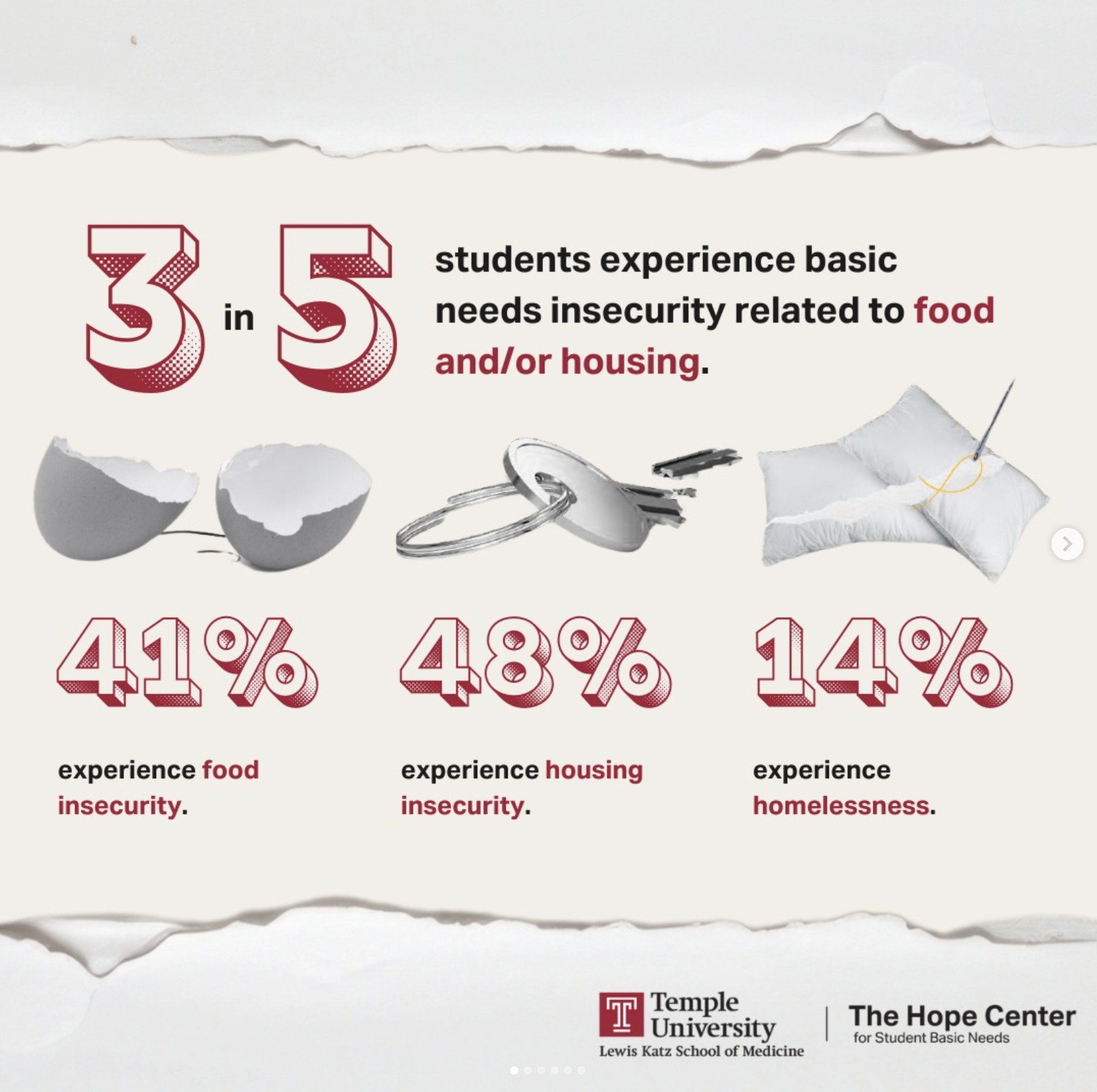
The Student Basic Needs Survey is the nation’s largest annual assessment of basic needs security among college students. The survey, created by the Hope Center for College, Community, and Justice (Hope Center), specifically evaluates access to affordable food and housing. This report describes the results of the most recent iteration of the survey launched in Spring of 2023—at two- and four-year institutions across the United States—through Summer of 2024.
Rates of basic needs insecurity are higher for students attending two-year colleges compared to those attending four-year colleges. Rates of basic needs insecurity are higher for marginalized students, including African Americans, students identifying as LGBTQ, and students who are independent from their parents or guardians for financial aid purposes. Students who have served in the military, former foster youth, and students who were formerly convicted of a crime are all at greater risk of basic needs insecurity. Working during college is not associated with a lower risk of basic needs insecurity, and neither is receiving the federal Pell Grant; the latter is in fact associated with higher rates of basic needs insecurity.